Personal
Real-Time Digital Filter Engine
A difference-equation filter engine in C supporting FIR and IIR responses with circular buffers, validated on a Cortex-M4 across Butterworth and Parks–McClellan designs.
What it is
A real-time digital filter engine written in C. It implements a filter’s difference equation directly, so the same engine runs both FIR and IIR responses just by swapping the coefficients, and it uses circular buffers so each output sample costs a fixed, bounded amount of work no matter how long it has been running. I built it to run on an ARM Cortex-M4 and validated it against filters designed in MATLAB.
The difference equation, directly
A digital filter is a difference equation: each output sample is a weighted sum of recent input samples (the feedforward, FIR part) and recent output samples (the feedback, IIR part). Implementing that equation directly keeps the engine small and general:
- FIR uses only the input terms, so it is always stable and gives linear phase when the coefficients are symmetric.
- IIR adds the feedback terms, which buy a much sharper response from far fewer coefficients, at the cost of having to watch stability.
Since both are the same equation with different coefficient sets, one code path covers both.
Circular buffers for constant-time processing
The filter needs a short history of past samples, a delay line. A naive version shifts the whole history every sample, which gets more expensive as the filter grows. Instead I used circular buffers: a fixed block of memory with a moving index, so adding a new sample and dropping the oldest is O(1). Per-sample work stays constant and predictable, which is exactly what real time demands, since every sample has to finish inside the sample period.
Designing in MATLAB, validating on hardware
I designed the actual filters in MATLAB and brought their coefficients into the engine, then confirmed the engine reproduced the intended response:
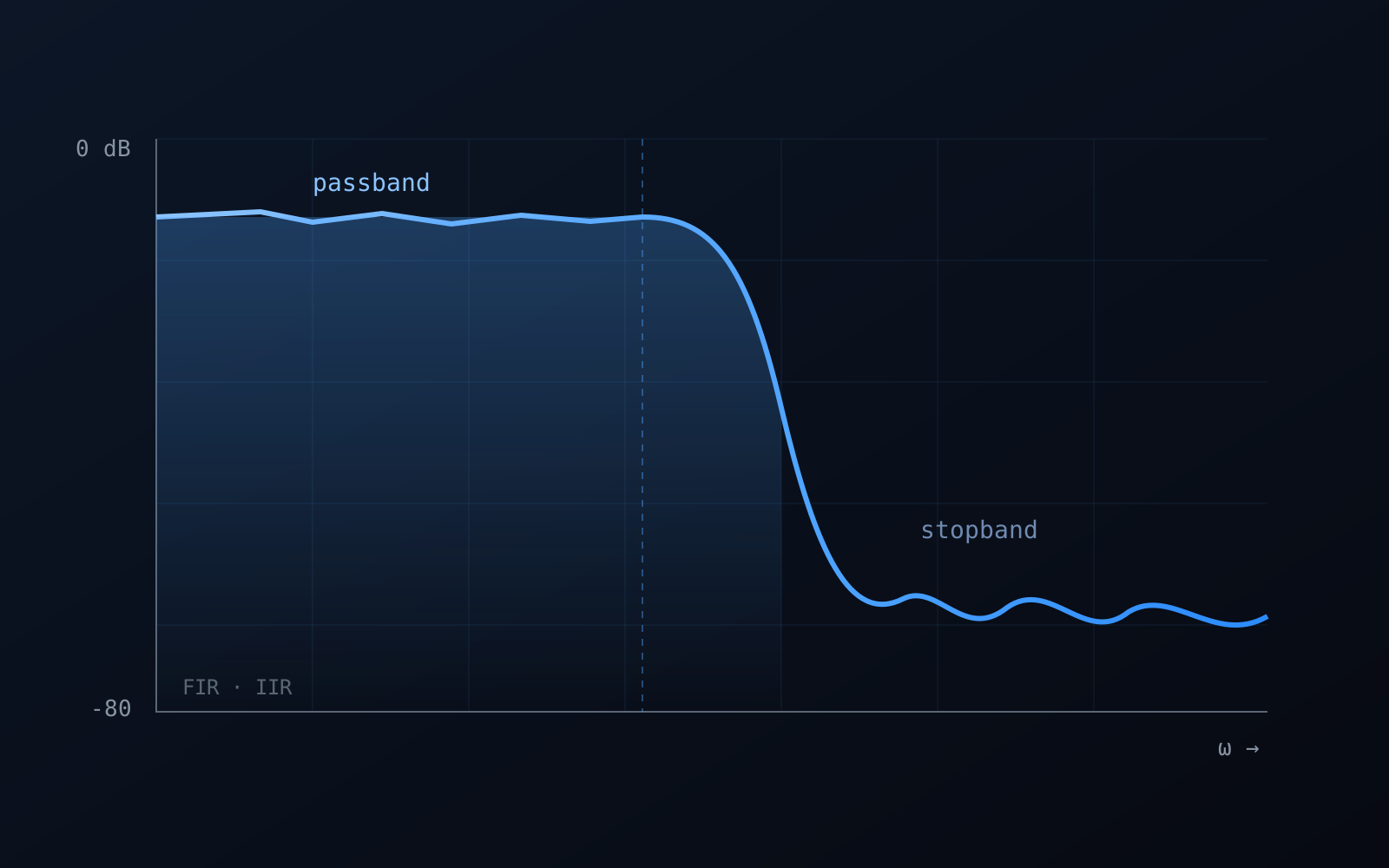
- Butterworth (IIR) for a maximally flat passband.
- Parks-McClellan / equiripple (FIR) for a sharp transition with bounded, controlled ripple.
Designing against a known-good MATLAB reference and running on the Cortex-M4 meant any deviation pointed at an implementation bug rather than a design question, which made the engine straightforward to trust.
What I took away
Building around the difference equation and circular buffers made this a general tool instead of a one-off filter: to get a new response, I design it in MATLAB and drop in the coefficients, and the real-time behavior comes for free.