Internship @ Hewlett Packard Enterprise
DDR Signal Integrity Validation Automation
An unattended Python pipeline that automates DDR eye-diagram capture across every direction, channel, and lane on a multi-channel ASIC platform, turning a 256-capture manual process into a single hands-off run, plus a web viewer for the results.
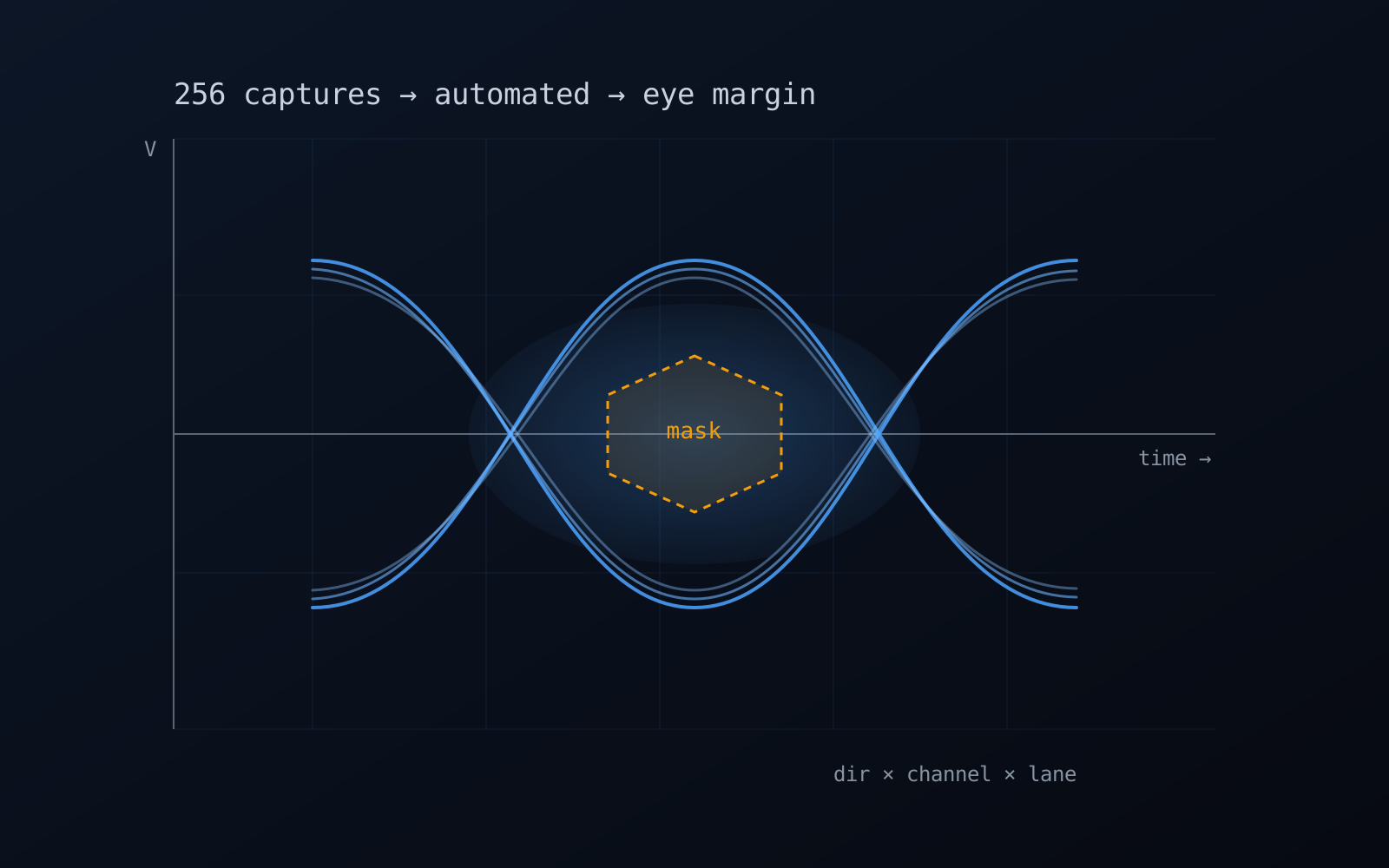
Work from my hardware internship on the networking R&D team, described at a general level, with no proprietary tool names, board codenames, driver modules, or internal details.
Context
On a multi-channel ASIC-based platform, I owned the automation of DDR memory signal integrity validation. Verifying DDR margins means capturing an eye diagram for every combination of read/write direction, memory channel, and data lane, and on the board I was working with that came to 256 individual captures. It had been done by hand, one capture at a time, clicking through an internal GUI. That does not scale, and every manual step is a chance for operator error.
What I built
I designed and implemented a fully automated capture pipeline that loops through every direction, channel, and lane, issues the correct low-level commands over a serial console session, waits for each capture to finish, and reboots the target between runs, all with no manual intervention. A multi-hour manual process became a single unattended run.
The interesting part was not the loop. It was everything that broke once a machine was driving real hardware fast and repeatedly, and had to recover on its own.
Engineering challenges I solved
Asynchronous control flow bugs. The original completion-detection logic never actually awaited the coroutine that parsed console output, so the automation silently failed to synchronize between steps. I traced it to an incorrectly bound lambda and rewrote it as a proper async function so each step genuinely waits on the one before it.
A race condition in device reset timing. The target had an effectively zero-second window to interrupt its autoboot sequence, and a fixed delay before sending the interrupt was missing that window intermittently. Instead of guessing at a delay, I detected the boot-imminent string in real time and fired the interrupt the instant it appeared. That fix then surfaced a follow-on issue, leftover buffer residue from the early interrupt, which I handled as its own step.
Root-causing corrupted data. Some captures came back with impossible timing values, the kind of numbers you get from an unsigned integer underflow. I traced it back several layers to a clock frequency register that was never being initialized, the result of a command-concatenation bug. Rather than just patch the symptom, I established a single diagnostic check, reading that register back, to confirm a capture was valid before trusting any of its data.
A kernel panic during device reset. The reset that had to run between captures was intermittently crashing the board with a kernel panic. I did root-cause analysis on the crash dumps and traced it to a NULL pointer dereference in a delayed workqueue callback inside a vendor-supplied FPGA driver: the driver was scheduling work against a PCIe endpoint that disappears during the reset. I evaluated several mitigation paths (module unbinding, selective PCIe function removal, shutting down the owning daemon) and documented why each was insufficient at the shell level, then escalated with a complete root-cause writeup pointing at the real fix needed in the driver or the reset sequence.
Data visualization tooling
I also built a web-based viewer with Streamlit and Plotly that parses the raw capture logs and renders the eye diagrams interactively. It includes an overlay view that compares every lane on a channel at once, so an outlier lane jumps out immediately, and support for merging captures that were split across multiple log files.
Skills demonstrated
Embedded systems debugging, asynchronous serial-console automation in Python, Linux kernel crash analysis, PCIe and driver-level root-causing, DDR signal integrity fundamentals (eye diagrams, timing and voltage margin, JEDEC mask concepts), and building internal tooling for hardware validation workflows.
What I want to build on
I want to go deeper on the hardware side of signal integrity itself: simulation-based margin prediction, and correlating measured eyes back to PCB trace geometry and stackup, rather than only the software automation layer around existing measurement tools.